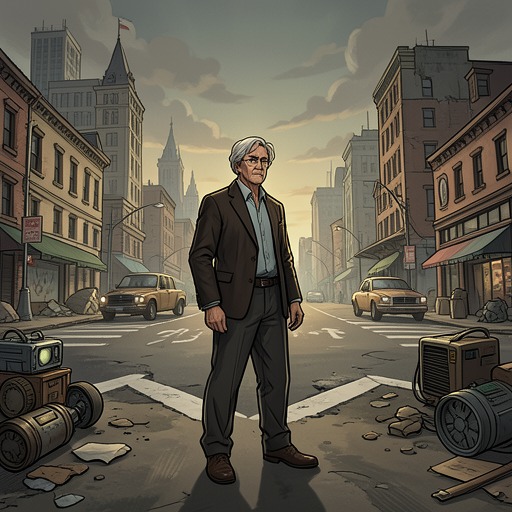
“She brings the green leaf from the stone”
The Dispossessed“She brings the green leaf from the stone” is a miners’ song that becomes an image of ecological repair and collective labor in The Dispossessed. Its words first reach Shevek on the Dust, where they name both the practical work of restoring a damaged landscape and the hope that something living can emerge from apparent barrenness. When the planting crews depart, the song returns as his way of understanding what they have made: a fragile beginning, not a completed redemption.
The song and its source
The phrase belongs to a song Gimar hums while returning to camp during the West Temaenian Littoral afforestation project. Shevek asks who the song’s “she” is; Gimar has no answer beyond the words themselves. She grew up in Southrising, among the miners, and says that the song is a miner song her tadde sang to her when she was little. Its origin is therefore remembered through family and community, rather than explained as a formal doctrine or given a named mythic figure.
The words continue, “From heart of rock clear water running.” Shevek hears religious significance in the image, but Gimar resists his tendency to turn ordinary experience into an abstract interpretation: it is just a song, she says, and its sense is plain enough in the work they are doing. The exchange leaves the referent open while grounding the image in a specific place and activity. Green leaves and flowing water are not yet present in the Dust; they are what the workers hope to bring back.
The Dust and the work of restoration
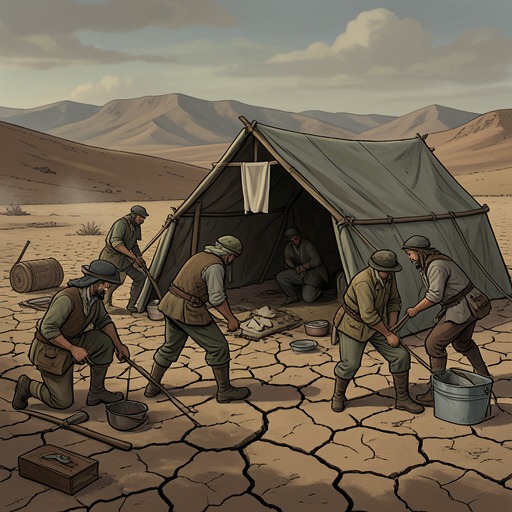
The song gains force from the landscape it accompanies. Inland from Anarres’s narrow, fertile southeastern coast, the region called the Dust stretches across the Southwest. In an earlier geological era it was forested with holums, the planet’s dominant plant genus. A hotter, drier climate and millennia of drought killed the trees and reduced the soil to fine grey dust, which the wind raises into barren hills. The afforestation project attempts to reverse that history by replanting the forest and restoring fertility to unsettled ground.
This is large-scale, organized work, not a solitary gesture: the project employs nearly eighteen thousand people over two years. The cost of the environment’s damage is immediate to the workers. At night in the camps they cough as fine dust clogs their throats and lungs; by day they keep planting. The dust is at once their enemy, the material they are charged with repairing, and the ground of their hope. The song’s image of green emerging from stone thus links the long history of ecological loss to the crews’ strenuous, collective attempt to make the land habitable again.
Shevek also connects the work to Causative Reversibility, a principle of temporal physics that he sees as an intimate, tacit element of Odonian thought. The project turns toward a damaged past in order to alter what the future can become: replanting is not merely a response to the present Dust, but an effort to make the old forest’s fertility possible again. At eighteen, Shevek thinks he lacks the knowledge to write about the relation between Odo’s ideas and temporal physics. His wish to return to physics sits uneasily beside the physical labor that gives the song its immediate meaning.
The song fulfilled, provisionally
By the second year Shevek is working in a planting crew. Trucks bring thousands of small trees, raised in the rainy Green Mountains, down to the Dust. When the fifty crews of that year’s project finish and drive away, they look back at the land. A faint mist of green lies across the desert’s pale curves and terraces, a light veil of life on dead ground. The workers cheer, sing, and shout between the trucks. Shevek’s eyes fill with tears, and he recalls the song: “She brings the green leaf from the stone.”
The scene gives the lyric a visible, but deliberately modest, answer. The crews have not restored a mature forest; they have planted seedlings, and the green is only a faint beginning. The song’s promise is made credible through labor and made moving by its limits. Gimar has long since been posted back to Southrising, so Shevek’s recollection also carries forward the earlier conversation and the miner tradition from which the words came. Beside him on the jouncing truck, Beshun squeezes close and runs her hand along his dust-whitened arm, bringing the workers’ physical closeness into a scene otherwise focused on the land they leave behind.
A recurring image of shared possibility
The phrase’s importance lies in its movement between inherited song, ecological work, and Shevek’s own interpretation. Gimar’s account keeps it rooted in the miners’ community and in a childhood memory; Shevek’s association with temporal physics gives it a further intellectual resonance, without replacing its practical meaning. At the project’s end, the image is neither only metaphor nor a claim that the Dust has already been healed: it is a song that the workers’ effort makes briefly visible in the new growth.
Elsewhere in the novel, this image of giving what is absent or unavailable resonates with Anarres’s ethic of sharing. On Urras, Shevek calls himself the Beggarman because he brings no money or gifts and must accept what others give him; he says that an Anarresti can make Urrasti give rather than sell. Later, he rejects the idea that his scientific work must be sold and asks whether there can be such a thing as a gift, offering his theory to Urras, Hain, and other worlds for the common good rather than private power or profit. These episodes do not make the miner song a literal statement about physics or exchange. They echo its structure: something valuable is brought into a world where it is lacking, and its significance depends on whether it can be shared.
The novel also sets this hope against the vulnerabilities of Anarres. The Dust is the outcome of prolonged drought, while the later Great Drought leaves the twenty million inhabitants dependent on holum for food, clothing, and other necessities; water is rationed and the land receives it before the baths. During the emergency, strained transport fails as well: Shevek’s train stops for twenty hours after a wreck, and a town without surplus food cannot feed four hundred and fifty stranded travelers without putting its own one hundred and sixty residents at risk. A man who once made ration lists at Elbow remembers that people too sick to work could receive only half rations, too little to recover. The green leaf from stone is therefore not a guarantee against scarcity or a claim that solidarity succeeds automatically. It names the work of making life possible, while the novel’s recurring tests of food, water, transport, and distribution show how fragile that possibility remains.